
·
Companies will support software
interoperability and advance open standards for industrial simulation,
collaborative design and AI infrastructure systems
·
Software portfolios of the
three companiesaid the creation of digital twins, improving building design,
sustainability, and equipment optimization across multiple industries,
including buildings, grids, and AI factories
·
Companies align with NVIDIA’s
vision for scalable, simulation-ready (SimReady) assets that model the physical
world and leverage generative AI for smarter decision-making
Bangalore, November 24, 2025 : Schneider Electric, a
global energy technology leader, AVEVA, a
global leader in industrial software, driving digital transformation and
sustainability, and ETAP, the
industry and technology leader in power system design and operation, today
announced their membership in the Alliance
for OpenUSD (Universal Scene Description). The companies join industry
pioneers including NVIDIA, Pixar, Adobe and Autodesk in shaping the future of
interoperable digital twins and simulation-ready (SimReady) 3D assets. The
announcement was unveiled during Schneider Electric’s Innovation
Summit North America in Las Vegas, convening more than 2,500 business
leaders and market innovators to accelerate practical solutions for a more
resilient, affordable and intelligent energy future.
The announcement reinforces the companies’ commitment
to advancing open standards for industrial simulation, collaborative design,
and Gigawatt-scale AI infrastructure. OpenUSD is a
high-performance, extensible framework and ecosystem that enables seamless
interoperability between software tools and data types for building virtual
worlds and advancing industrial digitalization.
Joining the Alliance signals Schneider Electric,
AVEVA, and ETAP’s deepened alignment with NVIDIA’s vision for scalable,
physically accurate, and real-time digital twin environments, engineered to
simulate buildings, manufacturing factories, data centers, and AI
infrastructure systems of the future. Organizations are rapidly adopting NVIDIA
Omniverse libraries to develop digital twin solutions to model projects,
digitalize processes, and design systems to the highest standards of
performance, sustainability and energy efficiency.
Advancing open standards for industrial simulation,
collaborative design, and AI infrastructure systems
By adopting OpenUSD as a shared standard, the
companies are working closely with NVIDIA to unlock new possibilities for:
- SimReady
Asset Development: Creating
interoperable, simulation-ready models of physical infrastructure
components, like power and cooling systems, that can be orchestrated
within industrial digital twins that leverage NVIDIA Omniverse libraries. - Digital
Twin Collaboration: Enabling unified views of complex systems
such as data centers, energy grids, and industrial facilities that are
integrated with Schneider Electric’s platforms like EcoStruxure, AVEVA and
ETAP. The three companies’ multi-domain expertise across buildings, data
centers, factories, plants, grids, and infrastructure offers advanced
digital twin simulations for an array of industries. - Accelerated
AI Infrastructure Deployment: Leveraging
the NVIDIA
Omniverse DSX Blueprint and
NVIDIA Omniverse libraries to codesign gigawatt-scale AI factories with
reduced risk and faster time-to-market.
Schneider Electric’s SimReady assets are used
alongside applications with integrated NVIDIA Omniverse libraries, enabling
physically accurate, detailed simulations across industries, and accelerating
digital twin development. From manufacturers optimizing assembly lines, to data
center operators enhancing AI factory design and operations. The adoption of
OpenUSD and digital twins is driving improved energy efficiency, sustainability,
and resiliency.
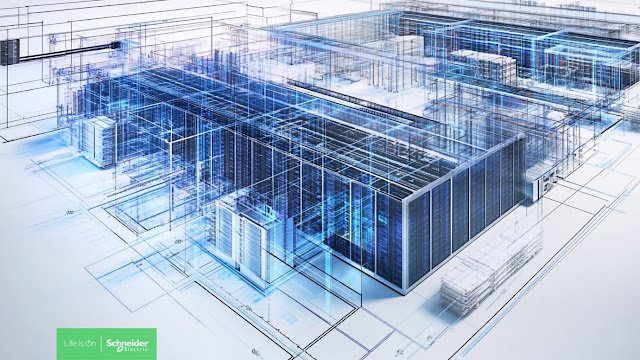
For example, by using AI factory digital twins, data
center operators can model and manage physical infrastructure systems that
simulate thermal behavior, power distribution, and airflow to optimize cooling
efficiency and reliability.
“OpenUSD is more than a file format, it’s a virtual
bridge between industries,” said Jim Simonelli, Senior Vice President and Chief
Technology Officer for Data Centers at Schneider Electric. “Joining the
Alliance allows us to contribute to a shared digital language that empowers
collaboration, simulation, and innovation across the AI ecosystem. It’s a
natural extension of our work with NVIDIA, allowing us to build AI infrastructure
that’s not only powerful, but intelligent, sustainable, and future-ready.”
“To efficiently design and operate complex systems
like AI factories, industries need a robust, simulation-ready foundation,” said
Rev Lebaredian, Vice President of Omniverse and simulation technology at
NVIDIA. “Schneider Electric’s expertise in energy management, hardware and
software, combined with NVIDIA Omniverse libraries, will accelerate the
creation of the AI factories and intelligent grids of the future, paving the
way for a new era of AI-driven efficiency and sustainability.”
Continued innovation, partnership, and impact
Schneider Electric, AVEVA and ETAP joining the
Alliance for OpenUSD (AOUSD) marks a
pivotal moment in the companies’ partnership with NVIDIA and builds upon
milestones the companies have shared throughout the years to accelerate digital
twin and AI factory development.
The companies are co-developing
reference architectures, integrated infrastructure and software
solutions that will power and cool the next generation of AI factories, and
working on projects that leverage NVIDIA Omniverse libraries to simulate and
improve energy efficiency in real-world environments.
At GTC DC, Schneider Electric was named as a power,
cooling, and energy technology partner contributing to the NVIDIA
AI factory Research Center in Manassas, Virginia. Powered by the NVIDIA Vera
Rubin platform, the center was built to support breakthroughs in
generative AI, scientific computing and advanced manufacturing and to serve as
a foundation for the Omniverse DSX Blueprint for gigascale AI factories. In March
2025, ETAP
by Schneider Electric unveiled a cutting-edge digital twin that can
accurately design and simulate the power needs of AI factories.